
JD(U) president Nitish Kumar and his son Nishant Kumar made a joint appearance at a party orientation programme, sparking speculation about Nishant's political future and potential leadership roles within the party. The event, aimed at training parliamentarians and legislators, also saw Nishant urging attendees to uphold his father's principles of "zero tolerance for crime, corruption and communalism."

More than half of the bills introduced in the 18th Lok Sabha have been passed by both Houses in the same session, a significant acceleration compared to previous terms, raising concerns about the time available for legislative scrutiny and stakeholder consultations.
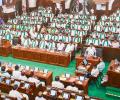
=In 21 states, the time gap between the general Budget and ministry-specific discussions was just one day.
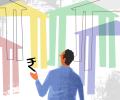
State debt is rising because revenues are disappointingly weak. Ten states have debt ratios exceeding 30 per cent. In 2023-2024, states were borrowing simply to meet day-to-day expenses, points out Debashis Basu.
A new report indicates that increasing unconditional cash transfer schemes for women across 12 Indian states are impacting their fiscal health, with six states projecting revenue deficits.

The Delhi assembly which held 74 sittings over its five-year term, met for an average of 15 days a year. On the days it met, the assembly sat for an average of three hours.

Nine re-elected MPs represented a different party in the 17th Lok Sabha, while eight others represented a party that split from their earlier party.

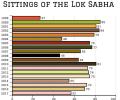
'With one more year remaining in the term, and 58 average sitting days a year, the 17th Lok Sabha is unlikely to sit for more than 331 days.' 'This could make it the shortest full-term Lok Sabha since 1952.'

According to an analysis by PRS Legislative Research, 172 bills were discussed and passed during the term of 17th Lok Sabha, of which 86 bills in the Lok Sabha and 103 bills in the Rajya Sabha were discussed for less than two hours each.
Coincidentally, the two first-term members got seats adjacent to each other in the House.
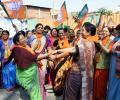
The eighth Delhi assembly will have fewer women members but a higher number of lawmakers with graduate degrees, according to a report.
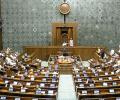
A large part of the productive time in Parliament is spent on non-legislative matters such as discussion on motion of thanks by the President, conduct of fellow MPs and so on.

'You cannot run Parliament with 800 MPs as nobody will get time (to speak in Parliament). And Parliament sits for barely 60 days in a year.' 'Look at the House of Commons of the United Kingdom. They have 650 MPs and they sit for 150 days on an average in a year.'

The outgoing Haryana assembly met for 72 sitting days over five years, or 14.4 days a year on average, against the national average of 23 days for state assemblies in the 2017 to 2023 period, according to an analysis by PRS Legislative Research.
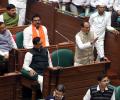
In 2022, Rajasthan met for 30 days, Chhattisgarh 18 days, MP and Mizoram for 15 each, and Telangana for 10 days.

The 17th Lok Sabha had 272 sittings altogether over its five-year tenure from 2019-2024.
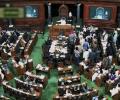
The first session of the 17th Lok Sabha began on June 17 and is scheduled to conclude on July 26.
All you need to know about the Winter session of Parliament.
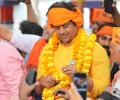
BJP MP and actor Ravi Kishan has been awarded the Sansad Ratna for his outstanding performance in the Lok Sabha, becoming the first actor-turned-politician to receive the honour.

The Modi government could steer through Parliament 59 out of 75 Bills.

Officials said the government is keen to conform to the convention of the Union Budget for 2026-2027 being presented on February 1 despite it falling on a Sunday in 2026.

In Maharashtra's 288-member assembly, the share of legislators with college degrees increased over the past decade.

The Lok Sabha, chaired by Speaker Om Birla, has been working for more than its scheduled time and has sat till midnight on two occasions to complete its legislative business.

The current batch of LAMP Fellows have been engaged in working with members of Parliament on several Parliament related research tasks. For details of the fellowship and the application process, please visit www.prsindia.org/lamp. Applications close on March 20, 2011.
The company also announced $765,000 for Bangalore-based Centre for Budget and Policy Studies, $660,000 for Centre for Policy Research, $1,015,000 for Institute for Finance Management & Research (IFMR) while NGO database information PRS Legislative Research will get $880,000.

Between 2019 and 2023, average sittings of the assembly in Chhattisgarh was 23 days a year, with average sitting time being five hours.
A graphical look at the performance of our MPs in both Houses of Parliament during the Budget session.
Parliament is expected to take up a motion for impeaching Justice Soumitra Sen of the Calcutta High Court. M R Madhavan (head of Research, PRS Legislative Research, New Delhi) explains the process of impeachment and the facts of this case.
According to C V Madhukar, a senior member of PRS Legislative Research, an independent Delhi-based think-tank, 'the debate on the Lokpal Bill reflected how Parliament functions about 80 percent of the time.' Rajni Bakshi on how we can engage better with Parliament.
Kerala had the highest number of average sitting days at 48 days a year, followed by Odisha (41) and Karnataka (35).

Catch all the debates and discussions from the Upper and Lower Houses.

In this exclusive interview with Parliament expert C V Madhukar, Founder and Director of PRS Legislative Research, he tells rediff.com's Sahim Salim that there is a need for a JPC to look into the smooth functioning of the Parliament, if for nothing else.

The last five years in Karnataka politics were marred by dissidence, confusion and instability. So not surprisingly, despite an impressive attendance record of 81 per cent, the state assembly convened for only 144 days in the past five years.
Anirudh Burman, analyst with New Delhi-based PRS Legislative Research, details concerns about India's nuclear power generation

'Even if it is defeated and the Speaker remains, the Opposition parties that have lost faith in his impartiality will continue to have that feeling.' 'If the Speaker reflects on this and tries to be more neutral, more impartial, more objective in his conduct -- then one can say the resolution had a salutary effect. That would be the best outcome.'
The Armed Forces (Special Powers) Act, 1958, or AFSPA, as it is commonly known, has of late been a subject of intense discussion and debate. AFSPA has been in force in the North-East and Jammu and Kashmir, and the 'draconian' law has been the reason of wide protests.
The Armed Forces (Special Powers) Act, 1958, or AFSPA, as it is commonly known, has of late been a subject of intense discussion and debate. AFSPA has been in force in the North-East and Jammu and Kashmir, and the 'draconian' law has been the reason of wide protests.
The students will spend four to five hours daily in assisting the MPs by getting them required inputs in a timely manner

The Budget session of Parliament was the least productive since the year 2000.
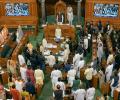
The 17th Lok Sabha has 12 per cent of its members below the age of 40. This is more than the 16th Lok Sabha, which had 8 per cent of MPs below the age of 40.
